


Where mobility will drive China and the West










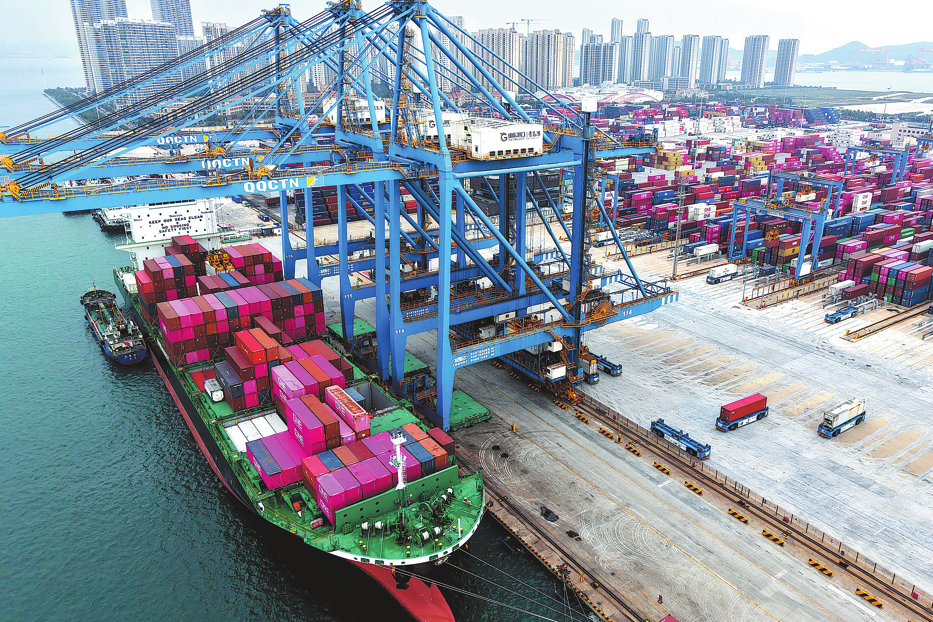
As China's latest Central Economic Work Conference set a confident tone for stabilizing growth and expanding high-standard opening-up, it underscored a clear policy signal: in a volatile global environment, China's priority is not short-term confrontation but strengthening the foundations of long-term economic resilience. Against this backdrop, the real driver of global economic integration is not tariffs or technology choke points, but mobility — the efficient movement of people, goods and data that underpins modern economic vitality.
Mobility has become the true nervous system of modern economies, and in the 21st century it is undergoing its most profound transformation since the invention of the internal-combustion engine 150 years ago. Electric, autonomous and connected technologies are redefining how we travel — and with it, how our cities, industries, and digital networks function. In this new era, China and the West will need to cooperate as much as they compete — or risk fragmenting the very architecture of the planet's mobility infrastructure.
Each wave of innovation in the field of mobility has followed a familiar arc.
In every wave, China has become the laboratory of scale. What was once ideated in Detroit or Stuttgart is now commercialized and scaled in Shenzhen and Shanghai. The innovation frontier has shifted from inventing new devices to orchestrating new ecosystems — and China has internalized that model more effectively than any other country.
A decade ago, Tesla reimagined the automobile as a piece of software on wheels — a continuously updated, connected machine whose value resides as much in code as in hardware. That insight has since become the organizing principle of the global auto industry. Yet it is China that has fully operationalized this paradigm at the system level.
Through deliberate industrial policy, China has built an end-to-end digital mobility stack: batteries, chips, vehicle platforms, smart roads, AI algorithms and urban data networks. The result is a mobility infrastructure that is both physical and digital — a national operating system in which electric vehicles, buses, drones and logistics hubs function as nodes in a unified data grid.
For Beijing, mobility is not simply an industry; it is the circulatory system of the modern economy. Upgrading it using advanced technology multiplies productivity across manufacturing, logistics and urban life. In this sense, China's approach to electric mobility echoes how the United States once treated railroads and aerospace- as strategic infrastructure central to national competitiveness.
The West still retains the world's most powerful innovation ecosystems- Silicon Valley, the German Mittelstand and Europe's sustainability leadership — but it struggles to mobilize them at scale. The US has allowed politics to cloud technological pragmatism, equating "energy independence" with fossil nostalgia. Europe continues to lead in regulation and design but remains constrained by fragmentation and slow execution. As a result, Western mobility strategies have become incremental, while China's are systemic.
Meanwhile, China now produces over 60 percent of the world's EVs and 80 percent of its batteries. Companies like BYD, Geely, NIO and CATL are defining the pace of industrial learning, while Chinese regulators are certifying urban air mobility corridors and autonomous driving zones. What was once a "catch-up game" has become a leadership contest.
Although China is leading in the sector, this leadership does not come without its share of growing pains. Profitability remains elusive for many original equipment manufacturers -a reflection of the fierce domestic competition. In effect, China is running the world's largest real-time mobility experiment, absorbing short-term inefficiencies in pursuit of long-term technological sovereignty and global competitiveness.
We are drifting toward two incompatible architectures: A Chinese-led ecosystem characterized by vertical integration, scale efficiency and unified standards. And a Western-led ecosystem shaped by private innovation, diverse regulation and political oscillation. If these systems diverge -with incompatible data protocols, duplicated supply chains and fragmented standards — the result will be delay, duplication, and diminished innovation.
The alternative is strategic interdependence. The global transition to sustainable and autonomous mobility cannot succeed without both sides: China's industrial scaling capacity and the West's software, design, and governance strengths. The most promising way forward is competition — or cooperative competition in which competitors benefit by cooperating with one another strategically -within shared rules of engagement, meaning interoperability, safety standards, and transparent data governance.
A compelling example of this emerging strategic interdependence can be found in the Gulf Cooperation Council region, which has rapidly become a real-world test bed for next-generation mobility systems. With ambitious national visions and strong investment in sustainable transport infrastructure, the Gulf states are uniquely positioned as neutral grounds for East-West collaboration.
In Saudi Arabia, for example, an Uber-led autonomous vehicle initiative in Riyadh — developed in partnership with China's WeRide — exemplifies how Western platform innovation and Chinese autonomous driving technology can align to deliver scalable solutions. Likewise, leading global autonomous driving technology company Pony.ai's partnerships with global original equipment manufacturers and technology firms reflect the growing trend of cross-border collaboration anchored in shared innovation objectives rather than geopolitical rivalry.
This emerging ecosystem will take center stage at CoMotion GLOBAL — the world's most influential gathering of urban mobility leaders from the US,Europe, China, and the Gulf in Riyadh this December — where they will shape the dialogue around collaboration, interoperability and sustainable scaling in the Mobility 3.0 era.
The GCC's open, experimental posture demonstrates that the future of mobility may be written not in Beijing or Washington, but in the new crossroads of innovation that connect them.
True mobility decarbonization will require industrial pragmatism: the West must leverage China's cost-efficient manufacturing base, just as China must align with international norms of IP protection and regulatory transparency. This is not capitulation, it is co-creation. The model is less Cold War, more Airbus-Boeing -competitive yet interoperable within a shared regulatory architecture.
The next decade will decide whether the Mobility 3.0 era becomes a story of integration or fragmentation. If we choose integration — linking China's physical scale with the West's digital expertise — the transition to a sustainable and intelligent mobility ecosystem could accelerate by years.
Mobility is no longer a consumer product. It is the strategic infrastructure of the digital economy — the platform upon which AI, automation, and global commerce will operate. The automobile defined the 20th century. The question now is whether the mobility revolution of the 21st century will divide the world — or connect it again.
Bill Russo is the chairman of the Automotive Committee at the American Chamber of Commerce in Shanghai and the founder and CEO of Automobility Ltd; and John Rossant is the founder and chairman of CoMotion and founder of the NewCities Foundation.
The views don't necessarily reflect those of China Daily.
If you have a specific expertise, or would like to share your thought about our stories, then send us your writings at opinion@chinadaily.com.cn, and comment@chinadaily.com.cn.