



Technology a game changer in solving China's cold cases









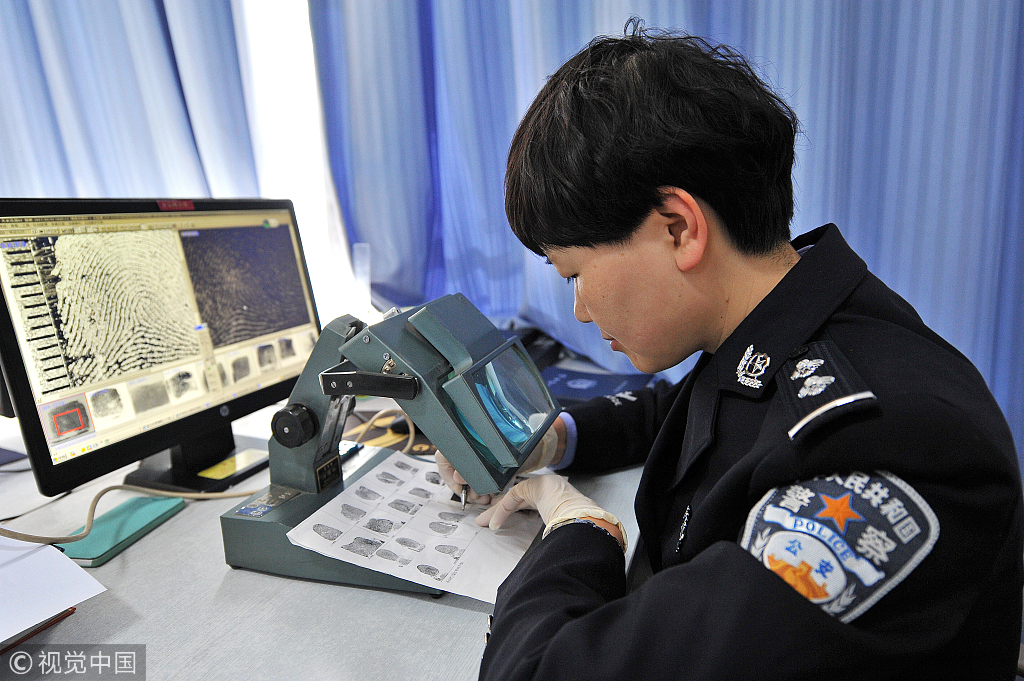
Last year, 41 cold cases were solved in Jiangsu, a developed coastal province in China, with the earliest crime committed 30 years ago. The figure was 29 in 2016, and 19 in 2015, the provincial public security department said Tuesday.
In east China's Zhejiang Province, all murder cases committed in 2017 were solved during the same year. Meanwhile, police solved 88 cold cases, around 70 percent of them using fingerprint, DNA, or facial recognition technology.
Crime shows make the audience believe DNA samples can easily convict the guilty and clear the innocent, but in real life it is more complicated.
The DNA has to match either a previous offender in the national law enforcement database or a sample from one of the victim's close relatives. When it does not, the investigation hits a wall.
A 58-year-old man surnamed Xu was caught by police in early March, 20 years later after he killed a prostitute at a recycling station in Lianyungang, Jiangsu Province, after a dispute over the fee he should pay her.
"DNA comparison played a key role in solving this case," said Liu Ying, a police officer in Lianyungang.
DNA use in criminal cases was still in its infancy in 1990s. When Lianyungang police set up its first DNA testing laboratory in 2004, investigators compared Xu's DNA profile with certain offenders in the national law enforcement database.
It did not lead to a match until recently when Xu committed another crime and his DNA sample was recorded by the database.
Jia Dongtao, a police forensics expert in Nantong, said that a more complete DNA database, advanced comparison methods, and higher DNA testing sensitivity have provided assistance in solving cold cases.
Jia is especially good at extracting DNA samples from bones a long time after death. His technique can increase the extraction success rate and cut the extraction time from one month to only two days.
According to Jiangsu police, DNA technology helped solve around 40 percent of all current cold cases last year.
Luo Wenjin, an official in charge of police forensics in Jiangsu, said that police investigation has entered the digital age. There are now DNA testing laboratories in all county-level police stations in the province.
"The technological advances used in criminal cases provide good tools for us to create a safer society," said Luo.






- Controversy erupts as Nanjing Museum's donated masterpiece surfaces at auction
- China's defense trade with Cambodia, Thailand unrelated to their border conflict: spokesman
- Over 3,400 foreign travelers utilize 240-hour visa-free policy to enter China through Xiamen
- China targets world-class Earth system forecasting network by 2035
- Crossing the red line means resolute counterattack, warns Chinese mainland
- Gaming, AI, animation highlight Digital Entertainment Conference in Guangzhou