

Workforce rides AI wave as new roles emerge
Fast-moving technology pushes employees toward more creative, high-value jobs










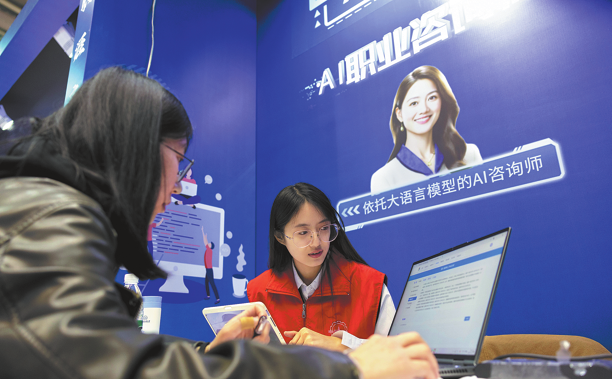
Just five years ago, much of this labeling work was outsourced to teams in smaller cities or rural areas, where workers tagged basic elements in vast image datasets such as cars, traffic lights, and street signs, which required less experience. But as AI models have grown more capable, they can now generate and refine some of their own data, reducing the need for humans to do the routine tasks.
"The competition is no longer about who has the most data, but who has the best data," explained Chen. "The real advantage now lies in high-quality, domain-specific information."
As a result, companies are shifting their focus. "More firms are now hiring trainers with professional expertise," Chen said. "Only carefully curated, expertly labeled data can make AI truly reliable in specialized fields — like medicine, law, or finance."
Cui Xian, 23, a finance graduate based in Shenzhen, Guangdong province, now works as an "AI data annotation specialist" at a major tech company. His role is to train AI to reason like a subject matter expert.
"I present it with complex questions it can't yet answer, then evaluate and guide its responses," he said.
"In a way, I'm not just feeding it data — I'm teaching it how to think through problems, understand concepts, and arrive at better solutions."
Yet Cui sees this work as a starting point, not a career. "The day the AI 'graduates' from your training could be the day your job disappears," he said. "The real skill isn't just teaching AI — it's learning how to use AI to elevate your own work."
He has since left the role to pursue a graduate degree, aiming to move into AI product management.
"Training AI taught me how the industry thinks," Cui said. "The true value isn't in teaching the machine — it's in learning to work alongside it."
As more workers engage with AI, many are discovering its potential not just as a tool but as a catalyst for personal growth — unlocking possibilities that once felt out of reach. Yan Qing, a 40-year-old Android developer, now runs his own AI-generated-content social media account, fueled by that same sense of possibility.
He recalls generating his first AI image in 2022 — a lighthouse by the sea. The rendering took more than 20 minutes. Yet the slow pace revealed something profound: a glimpse of a technology capable of reshaping creativity and efficiency. "It felt like witnessing a technological leap in history," he said.
As the technology matured, image-generation times shrank from minutes to seconds, producing crisp, high-quality results — a shift that helped Yan build and grow his platform.
Today, he sees himself as a "functional node" in an increasingly digitized world, curating and sharing new tools and techniques with a growing community of creators.
With AI agents spreading across industries, the idea of a "one-person unicorn" is edging closer to reality.
Zeng Ming, former chief strategy officer of Alibaba Group, has predicted that intelligent organizations — no more than 100 core employees with their abilities magnified by AI — could become mainstream within a decade. Management in such firms, he said, will shift from "people managing people" to "founders managing AI agents".
With AI support, small teams or even individuals can now carry out complex projects, said Lin, the marketer. "One developer plus several AI agents can handle product design, content creation and promotion — closing the loop from idea to execution," she said. That allows people to focus on exploration rather than repetition.
For Lin, an individual's mindset is what matters most. She suggested always asking how AI can help, whether in building mini-apps, making videos or even everyday tasks like cooking. Such habits can prepare people not only for entrepreneurship but for an era of greater personal freedom, she said.
Yan said: "There's no escaping this wave. Only by diving in can you learn its limits and potential. Even without a formal job, you can build experience through projects — laying the groundwork for what's next."
Chen, the algorithm engineer, sees AI as a foundational productivity tool — much like the steam engine. "AI is not only a job taker but also a job creator," Chen said.
Short-term disruption is inevitable, he said, but history shows that technological leaps ultimately create more jobs and more specialized forms of work. The real question, he added, is whether society can respond with openness and initiative.
China's education system is already adjusting. In 2024 alone, more than a dozen major institutions — including Tsinghua University, Harbin Institute of Technology, the University of Science and Technology of China and Wuhan University — have created or restructured AI schools.
More than 70 universities nationwide now host dedicated AI colleges, highlighting the rapid expansion of China's AI education landscape.
Yan believes AI will take over vast amounts of repetitive labor, pushing humans toward tasks once considered out of reach. "Low-quality work goes to AI. Humans must think more," he said. "Ultimately, AI is pushing work toward creativity and higher value."
Zhao Ruichun contributed to this story.